Water Safety for Individuals with I/DD: A Summer Supervision Guide
Water safety for individuals with intellectual and developmental disabilities requires dedicated, one-to-one supervision assigned specifically to watching the water, not shared with any other task, plus advance knowledge of each person's swimming ability, medical risk factors like seizure disorders, and a Coast Guard-approved flotation device whenever boating is involved. Drowning can happen silently and in seconds, which means prevention has to happen before anyone enters the water, not after.
Summer water activities are some of the best parts of the season for the people your agency supports. They're also one of the highest-stakes safety categories your staff will manage all year. Getting ahead of the risk is what makes it possible to say yes to the pool, the lake, and the boat trip with confidence.
Why This Population Faces Elevated Risk
According to the National Autism Association, citing a 2017 Columbia University Mailman School of Public Health study, children with autism face a drowning risk 160 times higher than the general pediatric population, and drowning accounts for more than 70% of deaths connected to wandering incidents. Lori McIlwain, co-founder of the National Autism Association, has noted that the danger peaks specifically in the early summer months, telling WebMD that the risk of an unnoticed exit rises in “May, June, July,” particularly around outdoor gatherings that sit near water.
The attraction to water isn't a behavior problem to correct. It's a documented pattern that safety planning has to account for. That's the mindset shift: water safety for this population isn't about telling someone to be careful. It's about building a supervision structure that doesn't depend on the individual recognizing danger on their own.
Medical Risk Factors That Raise the Stakes Further
Beyond wandering and attraction to water, specific health conditions compound drowning risk:
- Seizure disorders. A seizure in the water can happen without warning and removes a person's ability to keep their head above the surface. One-to-one supervision is required for individuals with seizure disorders, meaning not general lifeguard-style watching, but a staff member whose only job in that moment is that person.
- Cardiac conditions or dysrhythmias. Sudden changes in heart rhythm can cause loss of consciousness in the water, with the same one-to-one supervision standard applying.
- Medications that affect awareness. Some prescriptions cause drowsiness, dizziness, or slowed reaction time, all of which shrink the margin for error near water. Know each person's medication profile before the outing, not during it.
A Practical Supervision Framework
Assign, don't share. Water supervision should be a dedicated staff role, not something layered onto snack duty or general oversight. The moment a supervising staff member is pulled in two directions, the safety margin disappears.
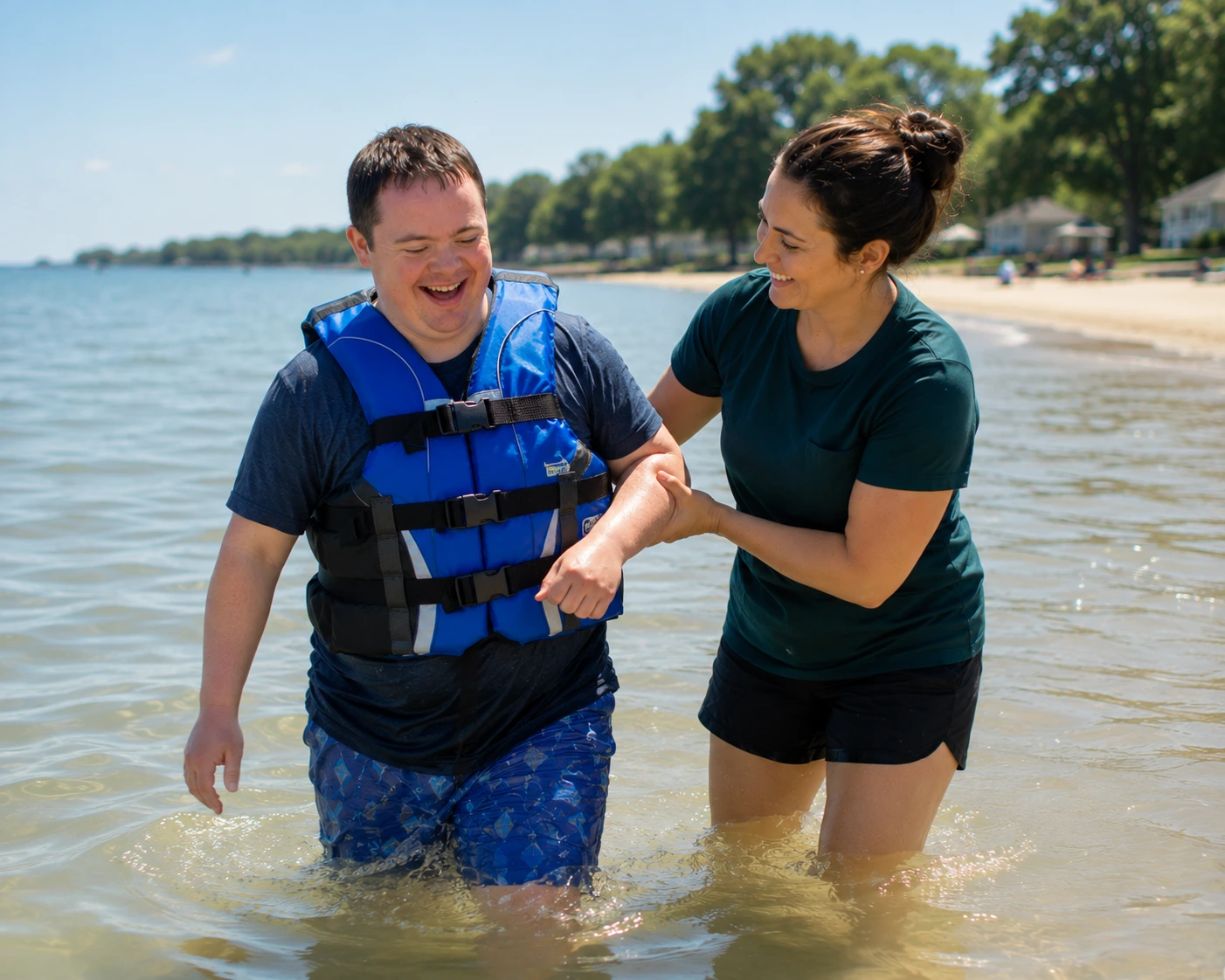
Get in the water. Having a staff member in the water alongside the individual, not just watching from the shore or poolside, is consistently the strongest approach for higher-risk individuals.
Know ability and comfort level before the outing. Don't assume. A person's comfort and skill in the water should be established and documented ahead of time, not discovered in the moment.
Choose less crowded settings when possible. Fewer people in the water makes it dramatically easier for staff to maintain a clear line of sight on the individuals they're responsible for.
Require flotation devices on boats. A Coast Guard-approved personal flotation device isn't optional equipment for boating outings. It's baseline gear, every time, for every person on board.
Treat conditions as changeable. Wind, currents, and crowd levels can shift the risk profile mid-outing. Staff should be prepared to adjust or pause the activity rather than sticking to a plan that no longer fits the conditions on the ground.
Before Anyone Gets in the Water
The strongest water-safety plans are built before the swimsuits come out. That means:
- Reviewing each individual's care plan for seizure history, cardiac conditions, and medications that affect alertness
- Confirming staff-to-individual assignments for water supervision specifically, separate from general outing supervision
- Packing appropriate flotation equipment for any boating activity
- Briefing staff on the specific individuals who require one-to-one water supervision that day